
🚚
🎁
Total: ₹0
Taxes and shipping calculated at checkout
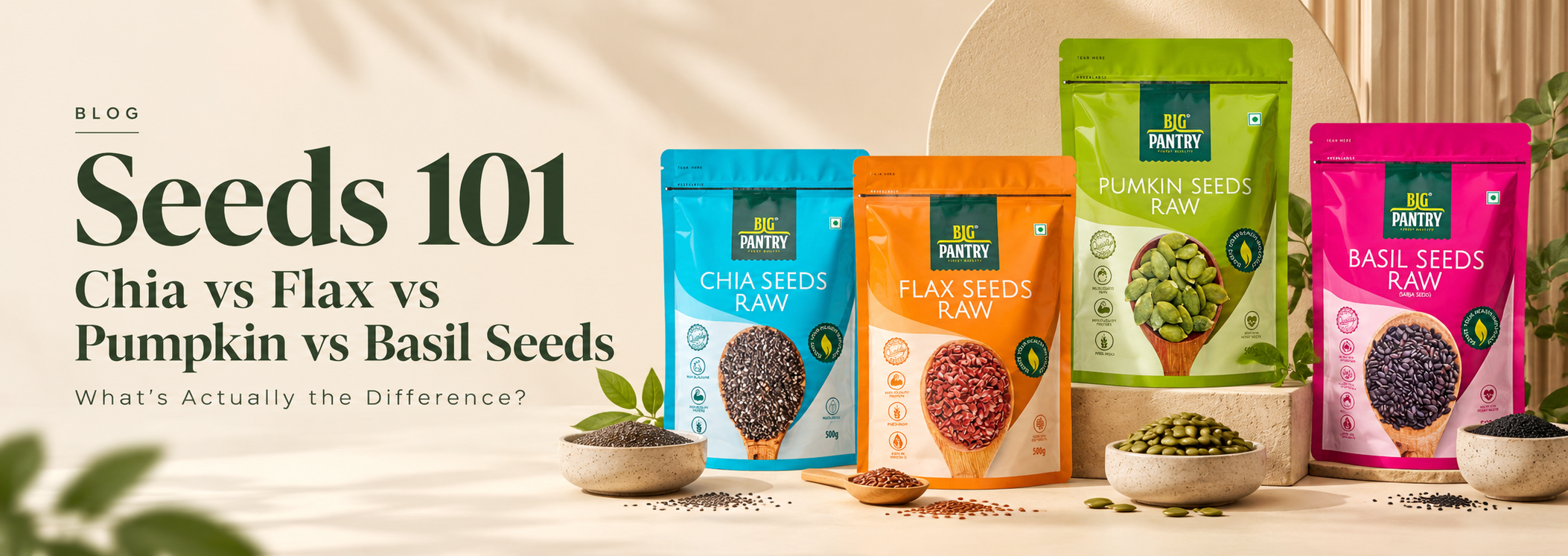
Walk into the “healthy foods” aisle and suddenly everything is a seed.
Chia seeds. Flax seeds. Pumpkin seeds. Basil seeds.
They all look small. They all somehow end up in breakfast bowls. And every second recipe on the internet seems to casually tell you to “add a spoonful of seeds” as though you already know which one.
But these four seeds are not interchangeable.
Some swell in water. Some need grinding. Some are made for smoothies. Others are perfectly happy being eaten straight from the pack. And if you have ever stared at four different seed packets wondering which one actually belongs in your kitchen, this is for you.
Welcome to Seeds 101.
The Quick Version
Before getting into the details, here is the easiest way to think about them:
Chia seeds: tiny, neutral and great for soaking.
Flax seeds: nutty, earthy and useful ground or added to recipes.
Pumpkin seeds: crunchy enough to snack on directly.
Basil seeds: fast-swelling seeds made for drinks and Indian-style coolers.
Same category. Very different personalities.
1. Chia Seeds: The “Put Me in Anything” Seed
Chia is probably the seed that benefited most from the smoothie-bowl era.
Tiny, black-and-grey and almost flavourless, chia seeds are incredibly easy to add to food without dramatically changing the taste.
Their most noticeable feature appears when you soak them.
Add chia seeds to liquid and they gradually develop a soft gel-like coating. That's why they work so well in chia pudding, overnight oats and beverages.
The texture is unusual the first time you try it, but once you get used to it, chia becomes ridiculously convenient.
What do chia seeds taste like?
Not much—and that's actually useful.
Chia has a mild flavour, which means your mango smoothie still tastes like mango and your chocolate pudding still tastes like chocolate.
It doesn't try to become the main character.
Easy ways to use chia seeds
Mix them into overnight oats, smoothies, yoghurt, breakfast bowls or homemade drinks. You can also make a simple chia pudding by soaking them in milk or a plant-based beverage until the mixture thickens.
Fruit works especially well here.
Mango + chia?
Good combination.
Berries + chia?
Also good.
Chocolate + chia?
We're listening.
The biggest advantage of chia is versatility. If you're new to seeds, it is probably one of the easiest places to start.
2. Flax Seeds: The One That Deserves More Attention
Flax seeds don't usually get the same Instagram treatment as chia.
Which is unfair.
They have a warm, mildly nutty flavour that works beautifully in everyday foods. Unlike chia, however, flax is commonly used ground because grinding makes it much easier to incorporate into recipes.
Whole flax seeds can still add texture, but ground flax is where the ingredient becomes particularly useful.
What do flax seeds taste like?
Slightly earthy. Slightly nutty.
They have more noticeable flavour than chia but are still mild enough to work with a wide range of dishes.
Where can you use flax seeds?
Try ground flax in atta, oats, smoothies, homemade granola or baked foods.
You can sprinkle it onto yoghurt or add a small amount to breakfast bowls.
Flax can also work surprisingly well in everyday Indian cooking because you don't necessarily need a special “health recipe” to use it.
Mix some into flour.
Add it to a dry chutney blend.
Sprinkle it over breakfast.
Done.
No elaborate Pinterest recipe required.
Chia vs flax: aren't they basically the same?
Not really.
Chia is generally more convenient when you want something that can soak and create a gel-like texture.
Flax has a nuttier flavour and is often more useful when ground and mixed directly into food.
Think:
Chia = soak.
Flax = grind and mix.
Not a universal rule, but a very useful shortcut.
3. Pumpkin Seeds: Finally, a Seed You Can Just Snack On
Pumpkin seeds are the easiest member of this list to understand.
They are bigger.
They are crunchy.
And you can simply eat them.
No soaking. No grinding. No complicated preparation.
Open the pack. Grab a handful.
That simplicity is probably why pumpkin seeds fit so easily into modern snacking.
What do pumpkin seeds taste like?
Mildly nutty with a satisfying bite.
Compared with chia, flax and basil seeds, pumpkin seeds feel much more like a conventional snack.
They're also excellent when combined with other ingredients.
Add them to trail mixes with almonds, cashews and dried fruit. Sprinkle them over salads or yoghurt. Use them as a crunchy topping for soup or breakfast bowls.
You can even add them to homemade granola.
Where pumpkin seeds really win: texture
Imagine a smoothie bowl with banana, berries and yoghurt.
Nice.
Now add pumpkin seeds.
Suddenly there's crunch.
That contrast is what makes them useful. While chia and basil seeds become soft when soaked, pumpkin seeds bring texture.
They are the seed equivalent of saying, “This needs something crunchy.”
4. Basil Seeds: The Indian Summer Drink Classic
Basil seeds—often called sabja seeds—have been appearing in Indian drinks long before trendy wellness cafés discovered seeds.
If you've had falooda, there's a good chance you've already encountered them.
Dry basil seeds are small and black, but soak them in water and they quickly develop a translucent gel coating around the centre.
They look similar to soaked chia seeds, which is why the two are often confused.
But they aren't exactly the same.
Basil seeds vs chia seeds: what's the difference?
The most obvious difference is how they behave.
Basil seeds generally swell quickly when soaked and develop a clearly visible gel-like outer layer.
Chia also absorbs liquid, but the final appearance and texture are slightly different.
Another practical difference?
Chia can easily be added directly to many foods.
Basil seeds are typically soaked before being used.
Where do basil seeds work best?
Drinks.
This is their territory.
Add soaked basil seeds to lemonade, rose drinks, falooda, fruit coolers or flavoured water.
They also work in milk-based beverages and some desserts.
If chia feels like the breakfast seed, basil seeds feel like the drink seed.
Okay, But Which Seed Should You Buy?
This is where people tend to overcomplicate things.
You don't need to choose the “best” seed.
Choose based on what you actually eat.
If you regularly make overnight oats, puddings and smoothies, chia seeds are easy to work with.
If you want something to mix into atta, granola or everyday recipes, flax seeds are worth keeping around.
If you're looking for a crunchy snack or topping, pumpkin seeds make the most sense.
And if you love falooda, lemon coolers or refreshing drinks, basil seeds belong in your pantry.
Better yet, keep more than one.
They aren't competitors.
They're doing completely different jobs.
Can You Mix Seeds Together?
Absolutely.
In fact, seed combinations can make more sense than using one type exclusively.
You could add ground flax and chia to overnight oats, then top the bowl with pumpkin seeds.
Or use pumpkin seeds in a trail mix while keeping chia for breakfast and basil seeds for drinks.
The trick is not to dump every seed you own into one meal just because the internet told you seeds are good.
Use them where they actually improve the food.
A little texture here.
A spoonful there.
Much easier.
How Should You Store Seeds?
Seeds are pantry ingredients, but storage still matters.
Keep them in a cool, dry place, away from moisture and direct sunlight. Make sure the pack or container is properly sealed after opening.
And yes, this is exactly where resealable packs become surprisingly useful.
Nobody wants to discover an open bag of seeds tipped over in the pantry two weeks later.
Ground flax deserves a little extra attention because once seeds are ground, more of the ingredient is exposed to air. Grinding smaller amounts when needed can be a practical approach.
The Biggest Seed Mistake? Buying Them Without Knowing What to Do With Them
We've all done it.
You see something healthy online.
You buy it.
It enters the pantry.
Three months later, it is still sitting there looking extremely optimistic.
So before buying a seed, decide on one easy use.
Buying Big Pantry Chia Seeds Raw? Start with overnight oats.
Buying Big Pantry Flax Seeds Raw? Add ground flax to atta or breakfast.
Buying Big Pantry Pumpkin Seeds Raw? Keep them near your snack shelf.
Buying Big Pantry Basil Seeds Raw? Make a chilled lemon drink.
Once an ingredient becomes part of one regular habit, experimenting with it becomes much easier.
Seed Cheat Sheet
Here's the version worth remembering:
|
Seed |
Texture |
Flavour |
Best For |
|
Chia Seeds |
Gel-like when soaked |
Very mild |
Pudding, oats, smoothies |
|
Flax Seeds |
Firm whole, fine when ground |
Mildly nutty |
Atta, baking, oats, granola |
|
Pumpkin Seeds |
Crunchy |
Nutty |
Snacking, salads, bowls, trail mix |
|
Basil Seeds |
Gel-like when soaked |
Mild |
Falooda, coolers, drinks |
So, Which One Wins?
None of them.
And that's the point.
Chia, flax, pumpkin and basil seeds may sit together in the same supermarket section, but they solve completely different kitchen problems.
Chia thickens.
Flax blends.
Pumpkin crunches.
Basil refreshes.
Once you remember that, the seed aisle becomes a lot less confusing.
The best seed isn't the one currently trending.
It's the one you'll actually use.
Explore Chia Seeds, Flax Seeds, Pumpkin Seeds and Basil Seeds from Big Pantry at www.bigpantry.in and find the ones that fit naturally into your everyday routine.


There is nothing in your cart lets add some items.


Subtotal ₹0
Shipping Charges Calculated on checkout


